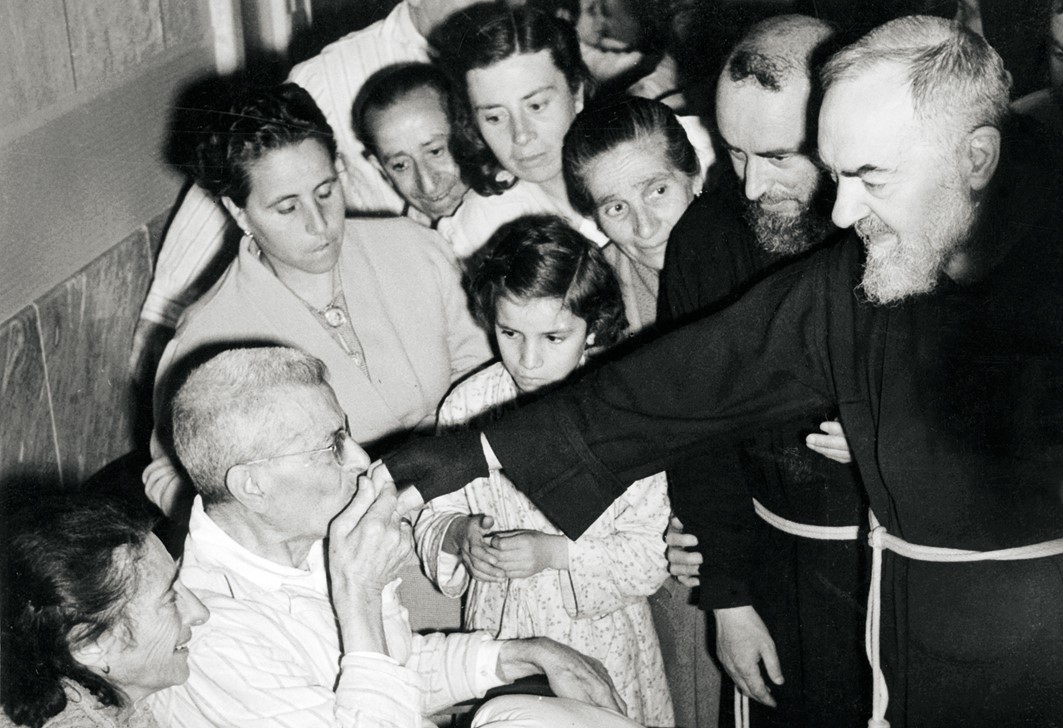
The Relief of Suffering
It is time to reflect on Padre Pio’s earthly mission: the physical relief of suffering, a cause he pursued tirelessly from his earliest days in San Giovanni Rotondo. He began to make this vision a reality by supporting local initiatives, often through financial contributions.
In 1925, he lent his support to the creation of a small hospital in the town, housed in a former convent of the Poor Clares. Named the “San Francesco Hospital,” it was modestly equipped, with a few beds and even a small operating room. However, the hospital’s operations were short-lived, hindered by the lack of commitment from those tasked with running it. Over time, it fell into neglect, and an earthquake in 1938 rendered it completely unusable.
By this time, a far greater and more enduring vision was beginning to take shape in Padre Pio’s heart—one he had nurtured since the very start of his ministry. This vision relied on the unwavering support of individuals who placed their utmost trust in him and whom he, in turn, trusted implicitly. These were people of complete selflessness, marked by their loyalty as spiritual children. Their only desire was to fulfill Padre Pio’s wishes, free from any personal ambition. They were fully aware of his long-cherished dream, a vision he had never kept secret. As the winter of 1939 drew to a close, they began speaking with him about it during quiet evenings, laying the groundwork for its eventual realization.
At last, they decided to form a committee to bring the vision to life. This pivotal moment occurred on January 9, 1940, in a small villa along the road to the friary—a prefabricated structure built jointly by two of Padre Pio’s most devoted followers: Guglielmo Sanguinetti, a physician from Mugello, and Mario Sanvico, an entrepreneur from Umbria. Among them was also Carlo Kisvarday, a native of Zara, who was, at the time, constructing his own villa near the friary.
Several other spiritual children of Padre Pio were present, and without delay, they drafted a working plan, outlining tasks and dividing responsibilities among themselves.
That very evening, the members of the committee visited Padre Pio in his cell to share what they had begun. He blessed their efforts and offered the first donation: a small coin given to him earlier that day by a devoted follower.
.
When Sanvico asked what name should be given to the project, Padre Pio said he would reflect on it. A few evenings later, on January 14, he gave his answer: Relief of Suffering.
Bringing Padre Pio’s Vision to Life
Thus began the extraordinary journey of Padre Pio’s work. News of the project spread quickly, both by word of mouth and through written communication. Carlo Kisvarday, appointed treasurer, meticulously documented every donation received, whether in money or material goods. His villa became the administrative and organizational hub of the initiative. During the war years, little progress could be made beyond collecting donations.
However, once the war ended, the project began to take physical form. Under Padre Pio’s guidance, the location for the site was finalized, a specific design was chosen from among several proposals, and the builder was selected: Angelo Lupi, an eccentric yet brilliant architect from Abruzzo, who had created the winning design himself.
The construction was given a tremendous boost by a substantial donation from the United States government, provided through UNRRA funds. This support was secured thanks to the advocacy of British journalist Barbara Ward, who met Padre Pio in the autumn of 1947 and became an unwavering supporter of his vision.
Amid opposition, difficulties, and attempts at sabotage, construction continued until the inauguration on May 5, 1956, attended by Cardinal Lercaro, state officials, and distinguished medical professionals from various nations.
By then, two of Padre Pio’s closest collaborators, Guglielmo Sanguinetti and Mario Sanvico, were no longer alive. Both had passed away prematurely: Sanguinetti in 1954 and Sanvico the following year.
The speech delivered by Padre Pio on the day of the inauguration, along with another he gave the following year on the first anniversary, prophetically outlined a vision for the development of the project. Over the decades, this vision has been meticulously brought to life by those who succeeded him in leading the work, aided by the generosity of thousands of benefactors from around the world.
Today, Padre Pio’s hospital is a true medical citadel, equipped with the most advanced technologies and facilities. It is also supported by numerous auxiliary initiatives, further amplifying its mission of service.