The Charismas: The Fragrance
What was it about Padre Pio that inspired such profound interest and veneration? Beyond the stigmata—the wounds of the crucified Christ—which remained visible on his hands, usually concealed by brown fingerless gloves that he removed only to celebrate Mass, there was something truly extraordinary.
These wounds alone would have been enough to set him apart as a figure of remarkable holiness. But they also emitted, at times, an unmistakable and heavenly fragrance. This scent would fill the air around him and, in certain instances, was even perceived by people in far-off towns, far removed from his physical presence.
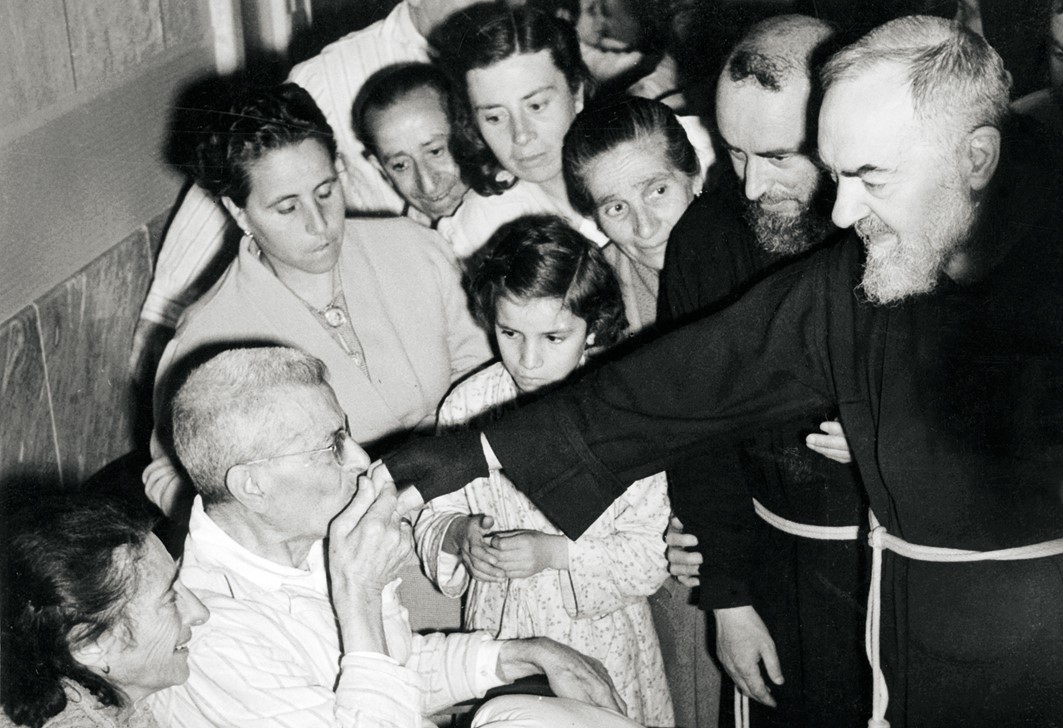
This phenomenon, miraculous in itself, drew people to him. After Mass, it became a fervent hope among the faithful to kiss his wounds before he returned to the sacristy to put his gloves back on. Many would search the table where he dressed and undressed, looking for small scabs that had fallen off as he handled his gloves. These tiny fragments, kept as relics, continued to emit Padre Pio’s distinctive fragrance, and were regarded as miraculous.
The Charismas: Insight into Souls
Beyond the extraordinary marks he bore on his body, Padre Pio possessed an exceptional gift: the ability to see into the innermost depths of souls, illuminated as he was by God. This was most evident during confession, where penitents would often find him bringing up sins they had not confessed. If the omission was unintentional and involved minor faults, the confession would proceed smoothly. But if the omission was deliberate and concerned grave sins, Padre Pio’s reprimands could be blistering, sometimes reaching the point of expelling the penitent from the confessional. These rebukes were delivered coram populo—in full view of others—because Padre Pio made no concessions. The humiliation was immense, not merely due to the public nature of the reprimand, which struck fear into those waiting their turn, but also because of the blow it dealt to the sinner’s pride.
Who did this friar think he was to treat someone in such a manner? By what right? By what authority? Many left outraged, vowing never to return. Yet, in time, most of them reconsidered, often with the help of compassionate intermediaries who explained the true nature of what had occurred, guiding them back to confession—if not with Padre Pio, then with another priest. Those who experienced such public rejection were often seen weeping afterward. These tears, however, were healing, allowing them to confront their sins and see their lives with newfound clarity. Padre Pio’s gift of discernment was not confined to the confessional. At times, in the midst of a crowd, he would publicly admonish someone, withdraw his hand when someone attempted to kiss it, or pass over an individual entirely when distributing Communion. On rare occasions, he would reprimand someone so harshly in front of others that it left the bystanders stunned.
There was always a reason for these actions—though it was often known only to the person being corrected.
The Charismas: Bilocation
The most compelling evidence of Padre Pio’s gift of bilocation comes from the saint himself. On one occasion, while speaking with his earliest spiritual daughters in the friary guesthouse during their usual spiritual discussions, he suddenly appeared absent. The episode lasted far too long to be dismissed as mere interior recollection.
When he finally returned to the present moment, someone asked what had happened. With characteristic simplicity, he replied that he had just been to America to visit his brother Michele.
Additional evidence of this extraordinary gift can be found in Padre Pio’s letters, where he refers to visiting Giovina, a bedridden spiritual daughter in Foggia. Giovina was the sister of Raffaelina Cerase, a woman with whom Padre Pio corresponded during his time in Pietrelcina. Raffaelina’s relationship with Padre Pio played a significant role in his eventual move to Foggia and later to San Giovanni Rotondo.
These two cases, which come directly from Padre Pio, provide clear examples of his bilocation. Beyond this, however, it is noteworthy that the distinctive fragrance associated with Padre Pio often served as a sign of his presence—or, at the very least, his intercession through prayer. This phenomenon was experienced even by people who had never met him personally.
The fragrance most often associated with Padre Pio was an intense and unmistakable scent of violets. Occasionally, however, people reported the smell of tobacco or even phenol.
Padre Pio had used phenol for a time as a disinfectant shortly after receiving the stigmata. As for tobacco, he sometimes sniffed it to clear his congested sinuses.
Many have attempted to assign specific meanings to the variety of scents attributed to Padre Pio, but such interpretations remain speculative.
What is certain is that Padre Pio’s presence or assistance was often felt, even from afar.
It is also undeniable that his blood, rather than emitting a repellent odor, carried a pleasant and distinctive fragrance. This scent would even permeate the handkerchiefs and cloths placed over his wounds.
Those fortunate enough to obtain one of these cloths—sometimes discreetly taken from his cell—would guard it jealously as a sacred relic, turning to it in times of need.
The Charismas: The Graces
Padre Pio’s intercessory prayers often obtained graces that could not be explained by human intervention, though in most cases they did not reach the level of outright miracles. The blessings received by those who sought his help are beyond measure, and this remains true even today. When asked to pray for a specific intention, he would immediately agree and encourage the petitioner to pray as well. One of Padre Pio’s favorite prayers, widely adopted by his devotees, was the “Chaplet to the Sacred Heart of Jesus,” which he recited daily.
At times, the intense fragrance associated with him served not only as a sign of his presence but also as an indication that a grace had been granted—and its effects often became evident immediately. Yet, when people tried to thank him, Padre Pio would typically say, “Don’t thank me; thank Our Lady.”
If a persistent devotee pressed him after witnessing something extraordinary, asking, “Father, was it you?” his usual response was a modest, “Who else would it have been?”
On other occasions, a simple remark he made about a deeply personal detail—something he could not have known through natural means—left no doubt about his intervention.